
 Search

Life cycle assessment of coolant systems in metalworking
The use of MWF is widespread in industrial metalworking, as their cooling, lubricating and flushing effects enable an efficient and cost-effective machining process. Conventional mineral oil-based metalworking fluids – either water-immiscible or water-miscible – are generally used for this purpose. However, the extraction, production, use and disposal of mineral oil are associated with a wide range of negative environmental impacts. Furthermore, the choice of metalworking fluid also determines how sustainable a machining process chain is.
Assessment of environmental impacts using crankshaft production as an example
A large proportion of the metalworking fluid used is carried away during the process as it adheres to the workpiece. Depending on the type of MWF used in the subsequent process step, a time-consuming intermediate washing step is required. To counteract these problems, Oemeta has developed the multifunctional oil HYCUT, which can be used both as a non-water-miscible machining oil and as a water-miscible emulsion. HYCUT has been developed using renewable raw materials. The potential environmental impacts of the system were investigated in a life cycle assessment.
In collaboration with the Institute for Machine Tools and Manufacturing Technology at the Technical University of Braunschweig, the potential environmental impacts of Oemeta HYCUT were examined using a life cycle assessment and compared with those of a conventional, mineral oil-based reference lubricant system.
Application of the life cycle assessment method at an Austrian engine plant
With a view to a holistic assessment of environmental impacts, the entire life cycle of a product is taken into account – from the extraction of raw materials through to product manufacture, use and disposal. Throughout this life cycle, both the resources consumed and the emissions generated by all processes under consideration are recorded and converted into environmental impacts.
The life cycle assessment was carried out as part of a case study at an engine plant belonging to a German car manufacturer in Austria. The study focused on the process chain for crankshaft production, which comprises a wide variety of machining processes, such as milling, turning, deep drilling and grinding. This process chain is characterised by frequent alternation between water-miscible and non-water-miscible metalworking fluids (see Figure 1).
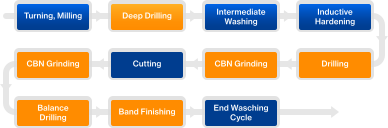
In practice, the process chain is already operated using the ester-based HYCUT, which is formulated in such a way that the water-miscible and non-water-miscible components are compatible. Consequently, the cross-contamination of metalworking fluid residues on components is not an issue, as is the case with conventional metalworking fluids.
Compared with mineral oil-based reference products, this leads to a significantly more efficient use of metalworking fluids throughout the entire production line, as intermediate washing steps and losses of metalworking fluids can be largely avoided.
In particular, the reuse of the cleaning fluid from component cleaning as an MWF for the machining processes has a positive impact on the life cycle assessment. To take full advantage of these benefits, the planners tailored the design of the production line to the process fluid. As a result, several component cleaning systems that would normally be required were not installed.
When the Oemeta HYCUT system is used, the environmental impacts across all categories considered are significantly lower (40–60 per cent) over the entire life cycle than in the reference system (see Figure 2).
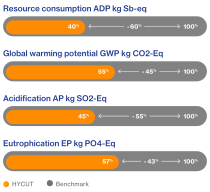
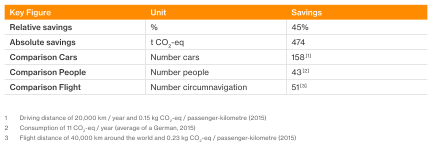
In terms of GWP (Global Warming Potential), a reduction of around 470 tonnes of CO₂-eq was calculated for annual production in the case studied. This saving is, for example, comparable to the environmental impact caused by the annual driving of 158 passenger cars¹. The absolute values calculated are specific to each case and depend on the basis for comparison, the system under consideration and the processes included.
The relative values indicate the general trend in the comparison. The life cycle assessment has therefore demonstrated that the use of Oemeta HYCUT in metalworking results in significantly lower environmental impacts than a conventional, mineral oil-based metalworking fluid system offering the same benefits.
See the figure below.

 United Kingdom
